- All
- Product Name
- Product Keyword
- Product Model
- Product Summary
- Product Description
- Multi Field Search
Views: 0 Author: Site Editor Publish Time: 2026-07-25 Origin: Site
Buyers choosing a Lab Grown Diamond Engagement Ring often experience a massive shift in purchasing power. You can suddenly afford larger center stones alongside intricate, premium settings. This newfound freedom allows you to upgrade your dream piece while staying strictly within budget constraints.
Increased budget flexibility often tempts shoppers to overlook structural integrity. Buyers frequently sacrifice certification standards and long-term wearability just to maximize pure carat weight. A massive stone mounted on a fragile band quickly turns into a costly repair nightmare. Prioritizing size over craftsmanship ultimately compromises the daily security of the jewelry.
This guide provides a clinical, step-by-step framework for designing and evaluating your piece. We show you how to effectively balance ambitious aesthetic goals with mandatory daily durability. You will learn to navigate verifiable grading reports and build a setting optimized for a lifetime of wear.
Reallocate traditional diamond budgets toward superior setting craftsmanship (e.g., platinum or higher-karat gold) and optimized cut grades.
Always require independent grading reports (IGI or GIA) to verify the lab diamond’s specifications; lab-grown does not automatically mean flawless.
Match the ring’s architectural setting to the wearer’s lifestyle, strictly avoiding ultra-thin bands (under 1.8mm) for everyday durability.
Vet jewelers based on their post-purchase infrastructure: comprehensive warranties, upgrade policies, and routine maintenance protocols.
The transparent pricing model of laboratory-created diamonds completely changes traditional engagement budget rules. Shoppers typically discover a massive cost advantage immediately. Laboratory diamonds routinely offer 40 to 70 percent savings compared to mined equivalents of the exact same tier. This dramatic price difference eliminates the need to compromise on essential design elements. You no longer have to choose between a quality stone and a secure setting.
We strongly advise reallocating these freed-up funds strategically. First, upgrade the setting materials. Shift your savings into highly durable metals like solid Platinum or 18K Gold. Platinum requires less maintenance over time because the metal displaces rather than scratching away. 18K Gold provides a richer, warmer hue while maintaining excellent structural stability for daily wear. Upgraded metals protect your center stone against accidental impacts.
Next, prioritize the "Cut" parameter above all other characteristics. Emphasize maxing out the cut grade before scaling up your carat size. Precision cutting dictates how brilliantly the stone returns light to the eye. Exceptional light performance easily hides minor inclusions and masks slight color tints. A perfectly cut 1.5-carat stone appears significantly larger and more vibrant than a poorly cut 2.0-carat stone. The sparkle draws the eye far more effectively than sheer diameter.
Finally, establish an objective reality check regarding long-term value. You should purchase this jewelry strictly for its emotional and aesthetic significance. These stones do not serve as liquid financial assets. They lack high secondary resale value on the open market. Accept this transparent reality early in the design process. It frees you to focus entirely on creating a beautiful, personalized piece of jewelry meant to be worn and enjoyed daily.
Independent grading remains an absolute necessity. Instruct your jeweler to only present stones carrying official IGI or GIA certifications. These independent laboratories act as objective referees in the diamond industry. Laboratory growth processes still produce natural variations, inclusions, and color shifts. Independent grading serves as your only legitimate safeguard against overpaying for lower-tier quality.
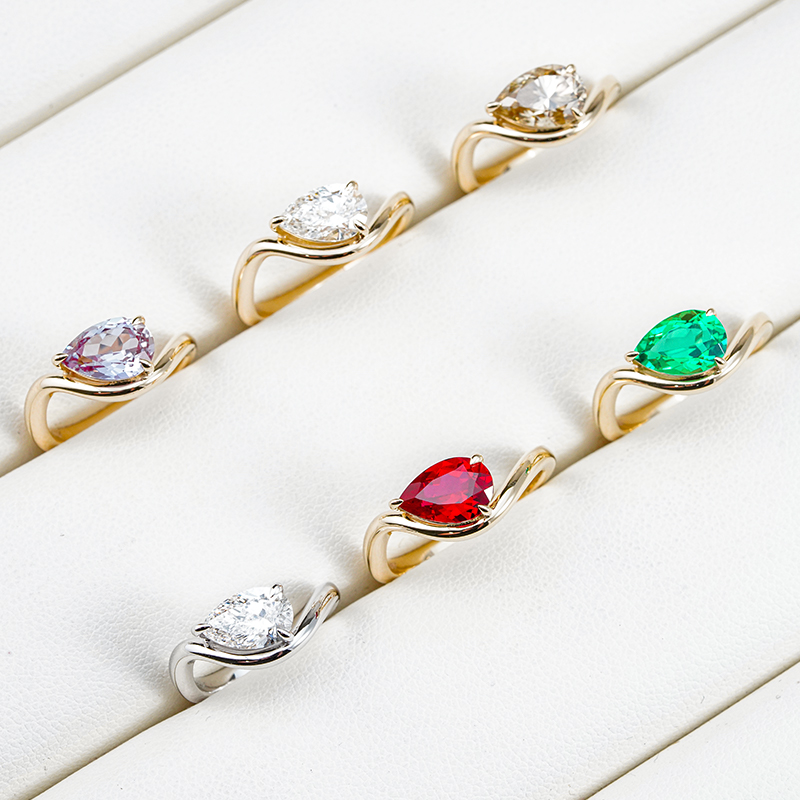
Evaluating fancy shapes requires rigorous attention to geometric details. Let us examine a pear cut lab diamond engagement ring as a benchmark for complex shape analysis. This specific silhouette demands precise proportions to look elegant rather than stubby. Always check the length-to-width ratio on the grading report. The ideal mathematical sweet spot falls strictly between 1.45 and 1.55. You must also assess bilateral symmetry. Poor symmetry creates lopsided points or bulging shoulders.
Furthermore, inspect elongated fancy shapes for the dreaded "bow-tie" effect. This phenomenon appears as dark, light-absorbing shadows running directly across the center of the stone. Heavy bow-ties ruin the visual appeal of the gem. You cannot judge a bow-tie from a paper certificate alone. Always request high-definition, 360-degree videos to inspect the stone's light behavior under neutral lighting conditions.
Understanding growth methods helps demystify the selection process. Chemical Vapor Deposition (CVD) builds the gem layer by layer in a vacuum chamber. High Pressure High Temperature (HPHT) mimics the intense forces found deep within the earth. Both methods create chemically identical gems. However, always review the comments section of the grading report. Look for notes regarding post-growth treatments. Some CVD stones require secondary heat treatments to remove unwanted brown undertones.
Review the comparison chart below to understand the subtle differences between the two primary manufacturing processes.
Growth Method | Creation Process | Common Visual Traits | Treatment Risk |
|---|---|---|---|
CVD | Layer-by-layer vacuum deposition | Can exhibit strain lines under magnification | Higher likelihood of post-growth color treatment |
HPHT | Extreme heat and mechanical pressure | May display metallic flux remnants | Rarely requires secondary color treatments |
Modern jewelry trends heavily favor whisper-thin bands. Social media platforms flood timelines showing massive stones floating on virtually invisible metal rings. We must debunk this dangerous trend immediately. Bands measuring thinner than 1.8mm simply lack the necessary tensile strength for daily wear. Everyday activities quickly warp thin metal. The band bends out of shape, the prongs separate, and you risk dropping the center stone completely.
Prong security varies drastically depending on your chosen stone shape. You must match the prong style to the geometry of the gem.
Round and Oval Stones: You must choose between four-prong and six-prong configurations. Four prongs offer a highly aesthetic, minimalist look. They expose more of the diamond to ambient light. Six prongs provide maximum structural security. If one prong snaps, the other five will still hold the gem firmly in place.
Pear and Marquise Stones: These elongated shapes feature extremely sharp, delicate tips. Standard prongs do not offer enough coverage. You must explicitly require V-prongs at these vulnerable points. V-prongs act as solid metal shields, wrapping over the tip to prevent devastating chips and cracks.
Princess and Emerald Cuts: Corners require similar protection. Heavy rounded prongs or customized corner caps protect the sharp right angles from impact damage.
Profile height directly impacts your daily lifestyle. You must assess how you use your hands before finalizing the architecture. High-profile settings elevate the diamond dramatically above the finger. They capture maximum light and allow straight wedding bands to sit perfectly flush against the engagement ring. However, high settings snag easily on sweaters, hair, and doorframes.
Low-profile settings offer the exact opposite experience. The culet of the diamond rests just above the finger. These rings feel incredibly secure and rarely snag on clothing. They suit active lifestyles perfectly. The main drawback involves wedding band compatibility. Because the basket sits so low, you will likely need a custom-contoured wedding band to curve around the center stone.
Buyers generally choose between two distinct implementation routes. Pre-set or "build your own" platforms dominate the modern e-commerce landscape. These systems offer rapid fulfillment. You can select a stone, pair it up, and receive the finished piece in just one to two weeks. Standardized quality control ensures consistent, predictable results. You also benefit from immediate visual previews.
However, pre-set platforms carry specific limitations. You remain restricted to their existing catalog settings. You cannot tweak highly specific micro-measurements. If you want a 1.9mm band instead of their standard 1.5mm band, the system typically will not allow it. Designing a truly unique lab grown diamond engagement ring often requires stepping away from mass-produced catalogs.
Fully custom design protocols give you absolute control over every millimeter of the ring. The workflow begins via a Computer-Aided Design (CAD) rendering. Next, the jeweler prints a physical resin or wax model. You review this model in person or via high-resolution video. Once approved, the jeweler proceeds to final metal casting. Set realistic timeline expectations for this route. A proper custom production cycle takes four to eight weeks.
Implement strict best practices during the custom phase. Demand highly detailed 3D CAD approvals before any metal casting occurs. You must meticulously verify two structural elements. First, check the gallery rail placement. This horizontal metal bar connects the prongs halfway up, preventing them from bending outward. Second, verify the exact prong thickness. Remember, liquid metal shrinks during the casting process. A CAD file showing a 1.8mm band might yield a final product measuring only 1.6mm. Ask your designer to mathematically account for this shrinkage upfront.
Selecting the right jeweler matters just as much as selecting the right stone. A high-quality vendor provides decades of post-purchase infrastructure. This infrastructure separates premium jewelers from transactional storefronts. Evaluate their long-term maintenance protocols before handing over your credit card.
Maintenance Services: Do they offer free annual prong tightening? Daily wear loosens prongs imperceptibly over time. White gold rings also require routine rhodium plating to maintain their bright, silvery finish. Ensure your vendor includes professional cleaning and replating in their service package.
Return and Exchange Policies: Look for a minimum 30-day, no-questions-asked return policy on all non-custom pieces. Shopping online requires this grace period so you can evaluate light performance in your own home.
Warranty Clarity: Read the fine print surrounding lifetime warranties. Many companies embed hidden void clauses. For instance, having a local third-party jeweler resize the ring often completely voids the original manufacturer's lifetime warranty.
Finally, thoroughly verify all ethical claims. The jewelry industry suffers from rampant greenwashing. If a vendor claims their products are "carbon neutral" or "100% sustainable," demand proof. Do not accept flowery marketing copy at face value. Look for official third-party sustainability certifications. Organizations like SCS Global Services conduct rigorous environmental audits. They verify energy usage, water management, and fair labor practices. A trustworthy lab grown diamond ring retailer proudly displays their audit results and certification numbers directly on their website.
Designing an exceptional engagement piece requires a fundamental shift in buyer mentality. You must move away from compromising on structural durability just to maximize stone size. Instead, use your increased purchasing power to demand uncompromising cut quality and superior metal craftsmanship.
Start your actionable journey today by shortlisting two to three certified stones carrying verified IGI or GIA reports. Keep these stones strictly within your predetermined budget. Next, map these specific gems to secure, lifestyle-appropriate settings. Prioritize bands exceeding 1.8mm in width and mandate V-prongs for any vulnerable fancy shapes. Combining precise gem selection with robust architectural design guarantees a stunning, lifelong investment.
A: Not with the naked eye or a standard jeweler's loupe. They share identical chemical, physical, and optical properties with mined diamonds. Specialized laboratory equipment is required to detect specific crystalline growth patterns. However, modern laboratory diamonds feature a microscopic laser inscription on the girdle denoting their origin and registry number.
A: No. Because they are structurally identical to mined diamonds, they do not fade, cloud, or change color over time. Any cloudiness you notice is simply an accumulation of surface dirt, lotions, and natural skin oils. A standard cleaning with warm water and mild dish soap restores their original brilliance instantly.
A: Insure it exactly like a mined diamond ring. Obtain an independent appraisal based on the retail replacement value, not the equivalent mined value. Submit this documentation to your insurance provider. You can easily add it to an existing homeowners or renters policy as a scheduled item, or utilize a specialized jewelry insurance provider.