
- All
- Product Name
- Product Keyword
- Product Model
- Product Summary
- Product Description
- Multi Field Search
Views: 0 Author: Site Editor Publish Time: 2026-04-24 Origin: Site
Buying jewelry online is thrilling until you open the delivery box. Many shoppers experience immediate "size shock" when unboxing their new purchase. This frustration stems directly from confusing industry sizing terminology. People mistakenly believe a carat measures visual size rather than physical weight. This common misunderstanding often leads to deep disappointment. It especially hurts when you are investing in high-ROI Diamond Earrings for daily wear. You must look beyond mere scale numbers to get what you truly want.
We will help you shift your focus. You will learn to prioritize visual diameter, physical wearability, and smart specification trade-offs. We introduce a clear framework to evaluate actual millimeter sizes and earlobe proportions. We will also explore how setting physics work and uncover the hidden costs of matching pairs in Diamonds Jewelry. This guide gives you the exact tools you need before you finally check out.
The CTW Rule: "1 Carat" usually means 1.00 Carat Total Weight (0.50 carats per ear), measuring roughly 5.0mm in diameter.
Cut Dictates Spread: A poorly cut 1-carat diamond hides weight in its depth, visibly shrinking the face-up size.
The Golden Proportion: Optimal everyday sizes typically cover 1/2 to 2/3 of the earlobe's width.
The "Earring Exception": You can safely downgrade clarity (to VS2/SI1) without sacrificing visual impact, reallocating budget to cut and carat size.
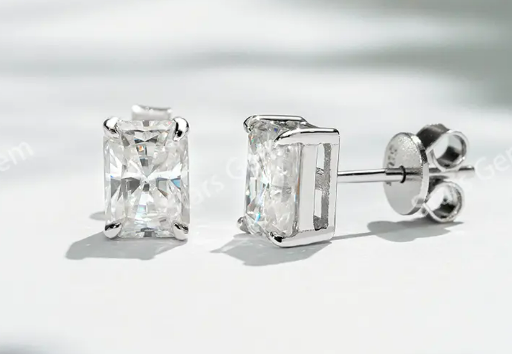
The most common point of post-purchase regret stems from one specific abbreviation. Buyers frequently misunderstand Total Carat Weight (TCW or CTW) versus per-ear weight. Retailers group stones together to calculate the final price tag. If a listing advertises "1 Carat Studs," you are likely buying two 0.50-carat stones. You are not receiving two 1.00-carat stones. This discrepancy creates a massive gap between expectation and reality.
To eliminate this guesswork, you need reliable baseline measurements. Carat dictates weight, but millimeters dictate visual reality. Let us map out the standard face-up diameters for Excellent-cut round brilliant diamonds.
Total Carat Weight (CTW) | Weight Per Ear | Approx. Diameter (MM) | Visual Anchor |
|---|---|---|---|
0.50 CTW | 0.25 Carats | ~4.0 mm | A large peppercorn |
1.00 CTW | 0.50 Carats | ~5.0 mm | A standard pencil eraser |
2.00 CTW | 1.00 Carats | ~6.4 to 6.5 mm | A small green pea |
You must also consider the shape variable. Standard round brilliants offer maximum sparkle, but they carry their weight evenly. Elongated shapes distribute their mass very differently. Oval, Pear, and Marquise cuts carry weight vertically rather than deeply. This specific weight distribution creates a larger visible footprint per carat. Jewelers call this concept "spread." A 0.50-carat oval will look noticeably larger on the earlobe than a 0.50-carat round stone, giving you a better size yield for the exact same budget.
Common Mistake: Buying a "Deep Cut" stone. Some manufacturers cut diamonds too deep to artificially retain heavier carat weights. A deep 1.00-carat diamond might only measure 6.0mm across. You end up paying for hidden weight you cannot see.
Just as tailors fit suits to body types, you should fit earrings to your specific anatomy. We recommend using the "Golden Ratio" of earring sizing. A diamond measuring half to two-thirds the width of your earlobe provides maximum brilliance. It stands out beautifully without looking heavy or overwhelming.
If your earlobe measures roughly 10mm across, a 5.0mm diamond (1.00 CTW pair) hits that 50% ratio perfectly. This mathematical approach guarantees an elegant, everyday aesthetic. Moving beyond the two-thirds threshold often pushes the look into formal or statement territory.
Beyond lobe width, you should evaluate your overall facial structure. Face shape shortlisting logic helps you choose the most flattering silhouette.
Round Faces: Geometric shapes provide excellent structural contrast. Princess and Emerald cuts add crisp angles that balance softer facial curves.
Oval and Long Faces: Standard Round Brilliants maintain a soft proportional balance. They draw the eye outward, adding horizontal width to the face.
Angular Faces: Curved shapes soften prominent jawlines and high cheekbones. Pear and Oval cuts offer elegant, swooping lines that complement sharp features.
If you remain unsure about scale, try the DIY paper test. It is a highly effective, zero-cost scale preview. Cut a 5.0mm circle and a 6.5mm circle from a piece of paper. Hold them directly to your earlobe in front of a mirror. This physical mock-up instantly reveals your ideal proportion, preventing costly return shipments later.
You do not always need to buy heavier stones to achieve a larger look. Jewelers use clever optical illusions to maximize your visual return on investment. The way a metal setting interacts with a stone dramatically alters its perceived boundary.
Halo Settings: This technique places a micro-pave border of tiny diamonds around the center stone. Adding a halo can make a 0.50-carat center stone look entirely like a 1.00-carat diamond from a few feet away. It offers a highly cost-effective size upgrade for those who love intense sparkle.
Bezel Settings: A bezel setting encases the diamond's entire girdle in a solid metal rim. When executed in white gold or platinum, this metal border seamlessly blends with the stone. The human eye reads the metal rim as part of the gem. This neat trick extends the visual boundary, making the stone appear up to 20% larger.
You must also evaluate the profile and fit of your chosen architecture. How a stone sits against the ear matters just as much as its face-up size.
Martini Settings (3-prong): This setting resembles a classic cocktail glass. It features a sharp V-shape profile that allows the diamond to sit incredibly flush against the earlobe. Martini settings are excellent for keeping heavier diamonds close to the body, minimizing any outward drooping.
Basket Settings (4-prong): This traditional architecture sits higher off the ear. A basket setting allows maximum light to enter the pavilion from the sides. However, this elevated profile increases the risk of snagging on sweaters or hair during active daily wear.
We must address the physical toll of larger stones. Diamonds approaching 1.00 carat each (2.00 CTW) carry significant mass. When you combine the weight of the stone with a solid gold basket, gravity takes over. The jewelry naturally wants to pull the earlobe forward and down.
We consistently warn buyers against wearing heavy studs with standard butterfly push-backs. Basic friction backs lack the mechanical grip needed to keep heavy jewelry upright. Over time, the constant forward pulling can permanently stretch your piercing holes. This stretching causes "droop," where the diamond points toward the floor rather than facing directly outward.
You can prevent stretching and ear fatigue by implementing robust mitigation strategies. Never treat the backing as an afterthought.
Require Structural Backings: Upgrade to threaded screw-backs for absolute security. Alternatively, choose specialized lifting backs (often called jumbo backs or La Pousette locks). These wide discs distribute weight across the back of the lobe, keeping the asset perfectly secured and upright.
Low-Profile Architecture: Emphasize settings engineered with a low center of gravity. The closer the diamond sits to the piercing hole, the less leverage gravity has to pull it forward.
Best Practice: If you plan to wear your earrings 24/7, including while sleeping or showering, locking push-backs provide the safest, most comfortable daily wear experience.
Buying earrings requires a completely different specification strategy than buying an engagement ring. We call this the "Earring Exception." Rings sit on your hand, easily inspected from twelve inches away under bright lighting. Earrings benefit from the viewing distance advantage. They are viewed from a social distance of two to three feet away, and they are constantly in motion.
Because nobody inspects your ears with a jeweler's loupe, you can radically reallocate your budget. You should compromise on specific parameters to fund a larger millimeter size.
First, aggressively downgrade clarity. A VS2 or SI1 diamond is entirely eye-clean from three feet away. Paying premium prices for VVS or Flawless grades here yields absolutely zero visual ROI. You literally cannot see the difference without magnification.
Second, exercise color leniency. Diamonds graded G, H, or I are highly cost-effective. They face up bright and white. This leniency works especially well if you set the stones in yellow or rose gold, as the warm metal naturally masks slight color tints in the gem.
Third, strictly prioritize the cut. You must always mandate "Excellent" or "Ideal" cut grades. As discussed earlier, a poor cut hides weight in a deep pavilion. If you compromise on cut, you might pay for a 1-carat weight but only receive a 0.8-carat visual diameter. Brilliant sparkle also masks minor inclusions, making an excellent cut your best defense against lower clarity.
You might wonder why a 2.00 CTW pair of earrings often costs more than two individual 1.00-carat loose stones. Buying pre-matched stud earrings carries an implicit premium. Human gemologists spend hours sorting through thousands of stones to find two perfectly identical matches. The diamonds must share the same exact diameter, table percentage, depth, color, and clarity. You pay for this intense labor and scarcity.
Lab-grown options systematically eliminate this scarcity cost. Because scientists grow these stones in controlled environments, finding identical pairs requires far less labor. This efficiency allows you to acquire larger sizes without absorbing traditional markup penalties.
Finding the perfect size for your daily wear sits at the intersection of your earlobe capacity, your daily lifestyle, and clever setting techniques. You do not have to blindly guess based on carat weight alone. By shifting your focus to millimeter spread and proper mechanical backings, you can secure an elegant, highly wearable investment.
Next Step Action:
Measure your earlobe width in millimeters to establish your personal 1/2 to 2/3 ratio.
Decide between a 1.00 CTW pair (for subtle, everyday wear) and a 2.00 CTW pair (for high visibility).
Filter your final shortlist strictly by Excellent/Ideal cuts to guarantee maximum visual diameter.
Confirm the inclusion of secure lifting backings or screw-backs before checking out.
A: No. A 1.00 CTW pair (0.50 carats per ear) is widely considered the definitive "everyday" sweet spot. They measure about 5.0mm in diameter, offering elegant sparkle without looking overwhelming or clashing with casual attire.
A: A single 1-carat stone (2.00 CTW pair) can cause drooping depending on your earlobe thickness. You can easily prevent this by utilizing specialized lifting backs or jumbo friction discs that distribute the weight evenly.
A: This is a psychological phenomenon where daily wearers perceive their diamonds as shrinking over time. You become accustomed to the sparkle. We advise against over-indexing on size alone just to chase a larger feeling.
A: Diamond pricing follows an exponential curve based on rarity. A single, large 1.00-carat rough crystal is exponentially rarer in nature than two smaller 0.50-carat crystals, making the single stone significantly more expensive.


