
- All
- Product Name
- Product Keyword
- Product Model
- Product Summary
- Product Description
- Multi Field Search
Views: 0 Author: Site Editor Publish Time: 2026-04-27 Origin: Site
Have you recently inherited jewelry or snagged a vacation deal? You might be wondering if those glittering stones are genuine. Second-hand market purchases and uncertified retail deals often trigger serious buyer anxiety. Verifying authenticity matters because you deserve to know the true value of your investment. It is rarely about a single magic test. Instead, evaluating gemstone authenticity requires a progressive elimination process. You must combine visual inspections, physical properties, and professional validation to get real answers. Evaluating Diamond Earrings involves looking closely at both the gemstone itself and the specific jewelry setting holding it. In this comprehensive guide, we break down practical at-home checks and highlight the scientific flaws of popular DIY methods. You will learn how to spot common simulants, use modern smartphone hacks, and know exactly when to call in a professional gemologist.
Setting signs tell the first story: High-quality diamonds are rarely mounted in cheap, unmarked metals.
Physics outsmarts fakes: At-home checks like the fog test rely on diamonds' unique thermal conductivity, but they are not foolproof.
Simulants have specific tells: Moissanite shows exaggerated rainbow flashes; Cubic Zirconia (CZ) is heavier and prone to scratching.
Lab-grown is real: Do not confuse synthetic diamond simulants (fakes) with lab-grown diamonds (chemically and physically identical to mined diamonds).
Pro tools are mandatory for final verdicts: Cheap thermal testers can yield false positives; checking for microscopic laser inscriptions or using dual thermal/electrical probes is the only secure route.
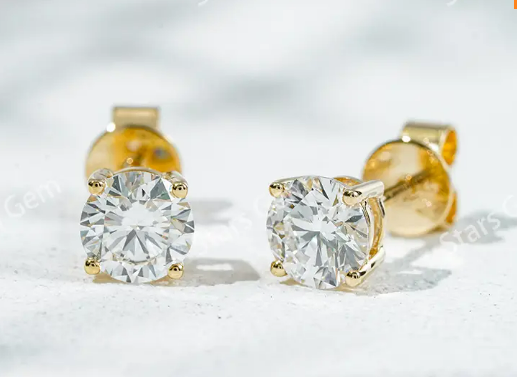
Business logic dictates a simple rule for the jewelry industry. Jewelers do not waste expensive stones on inferior hardware. Checking the mount is your fastest low-barrier screening. You can learn a lot about a gemstone simply by examining its surrounding environment.
Evaluation begins at the foundation. Check the earring posts and butterfly backs for specific stamps. Look for indicators like 10K, 14K, 18K, PT (Platinum), or Plat. Real diamonds demand high-quality metal settings to secure their value.
You should watch out for several immediate red flags. Seeing stamps like "CZ" indicates cubic zirconia. Lacking hallmarks entirely suggests cheap manufacturing. Visibly tarnished metal raises another massive red flag. These signs indicate a high probability of simulated stones. High-end designers rarely mount authentic diamonds in base metals.
Best Practice: Always use a magnifying glass to check the tiny butterfly backs.
Common Mistake: Do not assume a gold stamp guarantees a real diamond. Scammers sometimes mount fake stones in real gold.
Earrings are sold in pairs. Jewelers meticulously match the stones to ensure uniformity. Compare both earrings under a direct light source. Authentic diamonds display balanced fire (colored flashes), brilliance (white light reflection), and scintillation (sparkle movement).
Implementation realities require careful observation. Does one earring look milky while the other is sharp? Is the light return highly inconsistent between the two pieces? If so, suspect a fake or a replaced stone. Natural diamonds refract light in a highly controlled manner. Uneven light performance usually exposes a poorly cut simulant or a mismatched pair assembled hastily.
Diamonds score a perfect 10 on the Mohs Hardness Scale. They resist almost all daily wear and tear. Look closely at the edges where the individual facets meet. Authentic diamonds have razor-sharp edges. They maintain their pristine geometry over decades.
Glass or CZ will show rounded edges over time. You might also spot micro-abrasions, chips, or surface scratches. A second-hand earring showing visible surface damage is highly unlikely to be an authentic diamond. Inspecting surface wear offers a reliable clue about the stone's true hardness.
A skeptical, evidence-backed approach to DIY testing is crucial. Many popular methods have scientific rationale, but they also have notable fail rates. You must understand the science behind these tests to avoid false confidence.
To perform this test, breathe heavily on the stone to create condensation. Real diamonds are exceptional heat conductors. The fog should dissipate almost instantly. It usually clears in under 1 second. On CZ or glass, the moisture lingers for 2 to 3 seconds.
However, you must consider the risks and trade-offs. Moissanite also conducts heat remarkably well. It may pass this test easily. Therefore, the fog test remains an incomplete standalone diagnostic. It proves the stone conducts heat, but it does not confirm the stone is definitely a diamond.
This test profiles the material density of your stone. Follow these simple steps for the water test:
Fill a clear drinking glass with regular tap water.
Drop the loose earring directly into the glass.
Observe the sinking speed. Real diamonds have a high density and will plummet straight to the bottom.
Only use this to test density. Heavy fakes like some CZ variants will also sink quickly. It merely rules out lightweight plastics or hollow glass. It cannot distinguish between a heavy synthetic simulant and a natural diamond.
Expose the earrings to a black light in a completely dark room. About 30% of natural diamonds will emit a blue glow (fluorescence) under UV rays. This blue glow serves as a strong indicator of natural origin.
Do not panic if you see nothing. A lack of blue glow does not mean the diamond is fake. Approximately 70% of real diamonds do not fluoresce at all. However, a distinct yellow, gray, or green glow heavily suggests a simulant. Use this test as a supporting clue rather than a final verdict.
Educating yourself on alternatives neutralizes the fear of the unknown. We use data-driven evaluation dimensions to separate fact from fiction. Knowing your enemy is half the battle in gemstone verification.
Gemstone Material | Mohs Hardness | Refractive Index (RI) | Primary Visual Tell |
|---|---|---|---|
Natural Diamond | 10.0 | 2.42 | Sharp white brilliance, controlled colored fire. |
Moissanite | 9.25 | 2.65 | Exaggerated "disco ball" rainbow flashes. |
Cubic Zirconia (CZ) | 8.0 - 8.5 | 2.15 | Glassy look, prone to surface scratches over time. |
White Sapphire | 9.0 | 1.77 | Cloudy or milky appearance under harsh lighting. |
Moissanite presents the toughest challenge for amateur buyers. It has a higher Refractive Index (2.65) compared to a diamond (2.42). It also ranks extremely high on the hardness scale.
The tell lies in the light return. In sunlight, Moissanite creates a strong "disco ball" effect. You will see exaggerated, colorful rainbow flashes. Diamonds reflect primarily white light. They show distinct, controlled flashes of color. If the earring sparkles like a prism on overdrive, you likely have Moissanite.
CZ is much softer, scoring between 8.0 and 8.5 on the Mohs scale. It is also significantly heavier than a diamond of the exact same physical size.
CZ lacks the sharp brilliance of a diamond. It often looks lifeless or overly glassy after minimal wear. This happens because it accumulates micro-scratches quickly from daily exposure. A CZ earring older than a few months will rarely maintain a pristine surface.
Market realities have shifted dramatically in recent years. Lab-grown stones are 100% real Diamonds Jewelry. They share the exact chemical crystal lattice of mined stones. They are simply grown above ground instead of pulled from the earth.
Lab diamonds easily pass standard visual, fog, and hardness tests. They will even pass standard thermal probes. Experts can only distinguish them from natural stones via advanced laboratory spectroscopy. Do not confuse synthetic diamond simulants (fakes) with lab-grown diamonds.
Bridging the gap between amateur observation and professional validation ensures security. Standard industry tools provide definitive answers. You can also use modern technology to perform intermediate checks.
Almost all modern certified diamonds feature a microscopic laser-inscribed serial number. You can find this inscription on the girdle, which serves as the stone's equator.
Instead of buying a professional jeweler's loupe, grab your smartphone. Use the macro lens setting on modern phones (like newer iPhones or Android flagships). Zoom in closely on the earring's setting edge. Look carefully for the GIA or IGI serial number. Finding this number provides massive reassurance regarding authenticity.
Cheap handheld thermal probes test only for heat conductivity. You often see them sold online cheaply or used hastily in pawn shops.
These devices face a major technical limitation. They will frequently flag Moissanite as a real diamond incorrectly because both conduct heat well. Professional jewelers solve this by using dual-testers. These advanced devices measure both thermal and electrical conductivity. Moissanite conducts slight electricity; diamonds do not conduct electricity at all.
Professionals use a 10x jeweler's loupe to find "nature's fingerprints." They look for internal carbon spots, pinpoints, or feathers.
A completely flawless stone viewed under 10x magnification is highly suspicious. It is statistically more likely to be a piece of glass, CZ, or a highly controlled lab-grown stone than a natural diamond. Natural diamonds form under chaotic earthly pressure. They almost always carry tiny internal birthmarks.
At-home checks like the fog test, setting inspections, and light refraction observations serve as excellent primary filters. However, they remain diagnostic clues rather than absolute proof. Simulants like Moissanite and CZ have grown increasingly sophisticated, tricking amateur eyes and cheap testing tools alike.
For definitive peace of mind, escalate the verification process. Before initiating a return or attempting to resell suspected fake diamond earrings, visit a certified gemologist. Professionals utilizing dual-probe testers and microscopes will provide the unassailable truth about your jewelry.
Inspect the metal hallmarks first to weed out obvious fakes.
Use the smartphone macro lens hack to search for laser inscriptions.
Never rely solely on a cheap thermal tester due to Moissanite false positives.
Always demand authoritative certification for high-value purchases.
A: Yes, as a basic visual tool. You can use your phone's flashlight to observe the stone's sparkle. Real diamonds reflect bright white light and subtle colors. You can also use the macro camera lens to zoom in on the stone's girdle to look for laser inscriptions or internal inclusions. However, no app can magically test a stone's density or thermal conductivity.
A: Professionals no longer recommend this myth. While diamonds can indeed scratch glass due to their supreme hardness, attempting this test is risky. You might permanently damage a high-quality simulant or inadvertently bend the delicate jewelry setting itself. Rely on safer optical tests instead.
A: It depends on the tester. Cheap thermal testers measure only heat conductivity. Because Moissanite conducts heat very well, it will easily fool these basic pens. Professional multi-testers measure both thermal and electrical conductivity. These advanced tools will correctly identify Moissanite and other fakes.
A: No. Roughly 70% of authentic natural diamonds do not exhibit any UV fluorescence at all. A lack of a blue glow proves absolutely nothing. However, if the stone emits a strange yellow, green, or gray glow under UV light, that is a true red flag for a simulant.


